Loading...
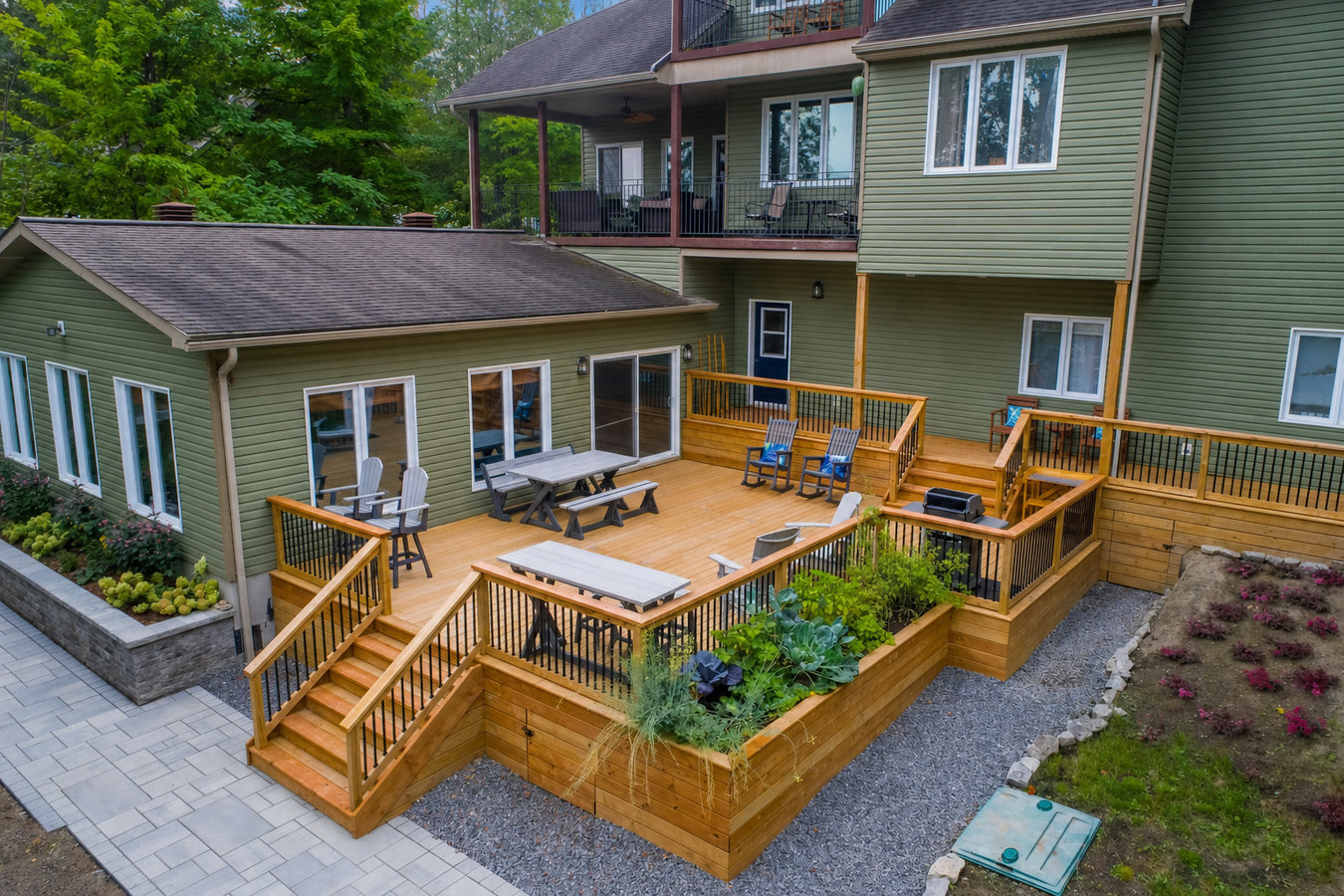
A single flat deck does not work for every yard. We build multi-level decks in Port St. Lucie that follow your lot, capture the view, and give every person in your household a place to use at the same time.
Multi-level decks in Port St. Lucie connect two or more platforms at different heights - usually following your yard's natural slope or separating activity zones - and most standard builds take one to three weeks of construction after permits are approved.
The best situation for a multi-level build is a yard that already has elevation change. Canal-front and preserve-edge lots throughout Port St. Lucie are exactly that - the yard drops off behind the house, a flat patio sits too low to be useful, and the view you paid for gets blocked by a fence. A tiered deck turns that slope into the feature instead of the problem. One level handles the grill and dining. Another gives you a lounging area or overlook. Built-in stairs connect them without eating into your yard footprint. If you are also considering a full entertaining setup, a multi-level design pairs naturally with custom deck design and build services that let you plan the layout from scratch around how your family actually uses the space.
St. Lucie County requires a building permit for any deck attached to a home, and that process adds two to four weeks before work begins. Your contractor handles the application, the drawings, and the county inspector visits. That paper trail matters when you sell - buyers and their lenders want to see a closed permit, and a deck built without one can become a deal-breaker.
If your lot drops off behind the house - common on canal-front and preserve-edge properties throughout Port St. Lucie - a flat patio at ground level either requires expensive fill work or ends up too low to use comfortably. A multi-level deck follows the slope, turning what feels like a problem into a feature. If you avoid the backyard because the grade makes it awkward, a tiered structure would transform the space.
If your existing deck works fine for two people but feels crowded the moment you host a family gathering or a few neighbors, you have outgrown it. A second level - even a modest one - can double your usable outdoor area without expanding your footprint into the yard. Port St. Lucie's long outdoor season means you will use that extra space far more than you might expect.
Many Port St. Lucie lots back up to canals, lakes, or natural preserves, but a low deck or ground-level patio puts you at eye level with the fence rather than the view. A raised upper deck level - even four or five feet higher than the lower platform - can open up a sight line that completely changes how you experience your backyard. If your lot's best feature is being wasted, a multi-level design is worth a conversation.
Florida's heat and humidity are hard on wood, and a deck that was not built with the right materials or maintained regularly will show it. Soft spots underfoot, boards that have turned gray and splintered, or gaps opening up between boards and the frame are all signs the structure is past its life. Rather than patching a failing deck, many Port St. Lucie homeowners use the replacement as an opportunity to expand and add a second level.
Every multi-level deck we build starts with what your yard actually looks like - how much it slopes, where the back door is, which direction faces the water or the preserve, and how you want to split up the space. Two-level builds are the most common: an upper platform off the back door for dining or grilling, and a lower platform that steps down into the yard for lounging or a fire pit area. Three-level designs make sense when you have more elevation to work with or want dedicated zones - a kitchen level, a seating level, and a yard-entry level, each connected by built-in stairs. All framing is engineered for Port St. Lucie's sandy soil, which requires deeper footings and proper post anchoring to keep the structure from shifting over time. Once the frame is in place, we install deck railing on every level that meets Florida height requirements - solid, properly anchored posts with baluster spacing that passes county inspection.
For decking boards, composite is our most-requested option in Port St. Lucie because it handles the wet-dry cycle of summer storms without warping, fading, or requiring annual sealing. Pressure-treated wood is available for homeowners who prefer natural wood and are prepared to maintain it. All fasteners are stainless steel or coated for coastal conditions - standard hardware corrodes quickly in Florida's salt-tinged air and near the waterways that line so many Port St. Lucie neighborhoods.
Best for homeowners with a yard that drops one or two feet, who want to keep the grill and table up top and have a relaxed lower zone to step down into.
Best for homeowners with significant slope or canal-front lots where each level can serve a distinct purpose and the top level delivers a real view.
Best for homeowners with a pool who want one level at the home's back door and a lower deck that wraps the pool surround for a connected, resort-style layout.
Best for homeowners who want every transition between levels to double as usable space - built-in benches on landing platforms and stair risers that anchor the design.
Port St. Lucie sits on sandy, low-density soil - different from the compact clay or rock that builders work with in other parts of the country. That sandy ground does not grip a post footing the same way, especially when a multi-level deck puts more structural load on the posts than a single-platform build does. Getting the footing depth and anchoring right is not optional here - it is the difference between a deck that holds its shape for twenty years and one that starts to lean or bounce within five. The North Fork of the St. Lucie River runs through and around this city, and a large share of Port St. Lucie lots back up to canals or waterways. Near the water, humidity is higher, salt air is a factor, and the soil stays wetter longer after each rainstorm. Every material choice - from the decking boards to the post hardware - needs to account for that. Homeowners in Tradition and similar planned communities also need HOA approval before any construction starts, which adds a step that contractors unfamiliar with the area often overlook.
Port St. Lucie gets roughly 55 inches of rain per year, with the heaviest stretch running June through September. Booking a large deck project in the fall or early winter means you avoid afternoon thunderstorms that halt outdoor work, and you have the best chance of a finished deck ready before the following summer. Homeowners in Stuart and nearby communities face similar conditions, and our crews build regularly across the Treasure Coast with those factors built into every design decision. Florida's hurricane season also puts real wind loads on any raised structure - our framing is built to Florida's residential wind requirements from the first footing, not as an afterthought.
We ask about your yard, your goals, and your rough budget before scheduling anything. This is a quick check to set realistic expectations - including Port St. Lucie's permitting lead times. You do not need a design in mind. We reply within 1 business day.
We visit your home to measure the space, look at the slope and soil, and talk through what you want each level to do. We will note your HOA situation and property line setbacks. You will have a written estimate within a few days of the visit.
Before any work begins, we submit a permit application to St. Lucie County - drawings, dimensions, and the connection detail to your home. If your community has an HOA, we help you prepare that submission too. Plan for two to four weeks for county review.
Work starts with post footings - the concrete anchors that hold everything in place. After the concrete cures, framing goes up, then decking boards on each level, then stairs and railings. A county inspector visits after framing and again at final completion.
Free estimate. No obligation. We know Port St. Lucie's permitting process and will give you honest timelines from the start.
(772) 281-0572Most of Port St. Lucie sits on low-density sand that does not hold a post footing the way denser soil does. We dig to the depth that St. Lucie County's code requires for the height and load of your specific design - not the minimum that might squeak through on a simpler build. That depth is what keeps a raised second level from shifting over time.
We submit the permit application to St. Lucie County Building and Code Regulation before a single hole is dug. A county inspector visits at framing and at final completion. You receive a copy of the closed permit with your records - the document that proves the work was done correctly and protects you at resale.
Port St. Lucie has one of the highest concentrations of HOA-governed communities on the Treasure Coast. We work regularly in communities like Tradition and PGA Village and know what the most common architectural guidelines require. We help you choose materials and colors that satisfy both the county inspector and your HOA board before ordering anything.
Post hardware, joist hangers, ledger bolts, and baluster fasteners are all stainless steel or coated for coastal Florida conditions. The{' '}North American Deck and Railing Association recommends coastal-rated hardware for any deck within miles of saltwater - and most Port St. Lucie lots qualify. Standard galvanized hardware corrodes here faster than homeowners expect.
Taken together, these details - deeper footings, proper permits, HOA familiarity, and coastal-rated hardware - add up to a multi-level deck that holds its shape and its value for years in Port St. Lucie's demanding climate. That is the difference between a deck that looks the same five years from now and one that starts showing problems as soon as the first rainy season arrives.
Every level of your multi-level deck needs compliant railings - we install aluminum, composite, and other railing systems that pass Florida's height and spacing requirements.
Learn MoreIf you want to plan the full layout from scratch - materials, levels, stair placement, and built-in features - our custom deck design process starts with your yard and your goals.
Learn MorePermit lead times in St. Lucie County mean the sooner you start, the sooner you are outside enjoying it - contact us today to lock in your build date.